Showing posts with label tourist information. Show all posts
Showing posts with label tourist information. Show all posts
Wednesday, 2 December 2009
Guia de Percursos Pedestres do Algarve
Guia de Percursos Pedestres do Algarve. https://visitalgarve.pt/en/28087/guia-d Guia de Percursos Pedestres do Algarve. -percursos-pedestres-do-algarve Link updated January 2025

Piódão, Chas d'Egua and Foz d'Égua
On Monday 30 November we did a geocache that took us to the Parque Arqueológico de S. Bartolomeu in Meruge near to Oliveira do Hospital. (The village of Meruge holds an annual fair of pork and sausage (ie Feira do Porco e do Enchido) each November which is worth visiting if you like pork).
Near to the Parque Arqueológico de S. Bartolomeu is a monument site called Sepulturas Antropomórficas. It is believed that the whole area has been inhabited by Romans, perhaps Visigoths, Arabs or Mozarab. Their graves at the site are clearly visible, carved in the granite (one child and five adults).

Yesterday, 1 December, it rained most of the day and night. But today was fine and we were off out geocaching again. This time we headed for Piódão, that is a historic schist village in the mountains (Serra do Acor).
On the way there we stopped at the Arte Rupestre: Centro Interpretativo de Chãs d´Égua, Arganil. The centre is closed Mondays and Tuesdays. Entry is free. The centre is very small and there is no information in English, but there are a couple of "finds" showing the carvings on pottery and on slate. There is also an information panel indicating where in the immediate landscape some of the artwork has been found.
We travelled further up the valley to Piódão and found an information board outside the tourist information centre outlining a circular walk around Piódão itself.

There are also slate waymarkers to nearby villages Foz d'Égua and Chas d'Egua but though we asked at the tourist information centre there were no maps available. The trouble with these walks is that the paths are not very well marked from what we can see. The original slate markers are sometimes broken or have disappeared altogether.
The best tourist information centre we have found is at Loriga. All of the others so far have not been able to provide us with the information we require, namely maps, leaflets or information about walks. Sometimes they indicate that you could try the another tourist information centre.
We are going to visit the Algarve to do some walking. The Algarve is currently about 3-5 degrees warmer than Central Portugal but cool enough for us to enjoy hiking and walking. We were chuffed when we discovered a booklet in Portugese entitled "Guia de percursos pedestres do Algarve" that looks really useful for exploring the Algarve on foot. But realistically we need it in English. On Monday we rang the tourist information centre in Albufeira (as we will be staying in that resort) and asked about the guide. No they didn't have it in English, and no they didn't have any of the Portugese versions either. They told us to try another tourist information centre. Is it us, or don't they get many English tourists on the Algarve, or maybe they just don't expect us to want to leave the beaches? It's quite disappointing that the tourist information centres are just really not equipped to help people who want to explore the country outside their car.
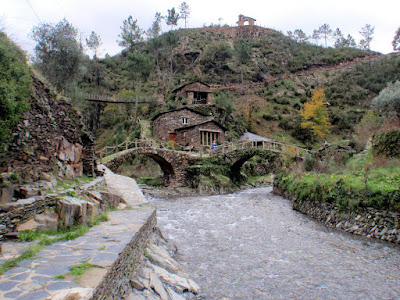
On the way back from Piódão we stopped at the really pretty village of Foz d'Égua. A lovely end to a lovely day out.
Near to the Parque Arqueológico de S. Bartolomeu is a monument site called Sepulturas Antropomórficas. It is believed that the whole area has been inhabited by Romans, perhaps Visigoths, Arabs or Mozarab. Their graves at the site are clearly visible, carved in the granite (one child and five adults).

Yesterday, 1 December, it rained most of the day and night. But today was fine and we were off out geocaching again. This time we headed for Piódão, that is a historic schist village in the mountains (Serra do Acor).
On the way there we stopped at the Arte Rupestre: Centro Interpretativo de Chãs d´Égua, Arganil. The centre is closed Mondays and Tuesdays. Entry is free. The centre is very small and there is no information in English, but there are a couple of "finds" showing the carvings on pottery and on slate. There is also an information panel indicating where in the immediate landscape some of the artwork has been found.
We travelled further up the valley to Piódão and found an information board outside the tourist information centre outlining a circular walk around Piódão itself.

There are also slate waymarkers to nearby villages Foz d'Égua and Chas d'Egua but though we asked at the tourist information centre there were no maps available. The trouble with these walks is that the paths are not very well marked from what we can see. The original slate markers are sometimes broken or have disappeared altogether.
The best tourist information centre we have found is at Loriga. All of the others so far have not been able to provide us with the information we require, namely maps, leaflets or information about walks. Sometimes they indicate that you could try the another tourist information centre.
We are going to visit the Algarve to do some walking. The Algarve is currently about 3-5 degrees warmer than Central Portugal but cool enough for us to enjoy hiking and walking. We were chuffed when we discovered a booklet in Portugese entitled "Guia de percursos pedestres do Algarve" that looks really useful for exploring the Algarve on foot. But realistically we need it in English. On Monday we rang the tourist information centre in Albufeira (as we will be staying in that resort) and asked about the guide. No they didn't have it in English, and no they didn't have any of the Portugese versions either. They told us to try another tourist information centre. Is it us, or don't they get many English tourists on the Algarve, or maybe they just don't expect us to want to leave the beaches? It's quite disappointing that the tourist information centres are just really not equipped to help people who want to explore the country outside their car.
On the way back from Piódão we stopped at the really pretty village of Foz d'Égua. A lovely end to a lovely day out.

Thursday, 26 November 2009
Loriga - Serra da Estrela
In contrast to today, Monday and Tuesday were beautiful. On Tuesday we went out geocaching in the Serra da Estrela to the town of Loriga. First we visited the turismo and managed to get loads of leaflets, some detailing walks in the area. On closer inspection some of these are circular and some are shorter linear versions tagged on to the main trails that run through the Serra da Estrela. Another booklet the lady in the centre gave us was outlining walking (and separate car) routes of the glacier valleys. These are all linear though so extra forward planning required. The lady in the tourist information centre spoke excellent English.
Next we grabbed a coffee, treated ourselves to a bottle of organic Medronho Brandy (and as it cost 22.90 euros it will be a treat!). We also bought some bread rolls and "Bon Bons" from a local bakery. The Bon Bons were like little doughnuts with a what might have been a custard filling.
Then we made our way up to where we knew there was a river beach (praia fluvial) at Loriga. We were not disappointed. The council have worked hard to make this a great place for all the family to visit and enjoy the river in it's wonderful surroundings. Today we were the only ones there and enjoyed our packed lunch in harmony with nature.

We then set off for the nearest geocache, ie Casa dos Ingleses (house of the English) or also known as "Penedo de Alvoco". It seems that the house was originally inhabited by locals (one of the inhabitants was born 1825 and died in 1900) but then the area was inhabited by English who were mining for metal in the area. One of these (by the name of James) died in November 1911 and was buried in the local cemetery. (In 1944 six English aviators were also buried in the same cemetery after crashing in the mountains).
Loriga info: It was an English military airplane; Hudson Aircraft, that had that day left Gibraltar for the United kingdom, carrying the following occupants: Captain-Robert Tavener HILDICK; Lieutenant-John BARBOUR; Lieutenant-Daniel De Waal WALTERS; Lieutenant-John Patie THOM; 1.Cabo-Jack Learoyd WALKER; 1.Cabo Henry Ernest HEDGES.
The Civil Register of Seia, registers the six deaths as having happened on 22 February of 1944. The assumption is that the plane came down in fog.
We returned to the village of Loriga and wandered along to the Roman bridge. But as it was getting late in the day we decided that further exploration (and other geocaches) would need to wait for another day.
We returned home to find a big bag of homegrown potatoes on the porch from our neighbours (recompense for the goats eating all our veggies). On Sunday they had given us one of their goat cheeses and asked if we wanted them to pay for the damaged crops. We would not accept any money, it wouldn't be right. Yesterday there were further gifts of cabbages and turnips, freshly harvested.
Next we grabbed a coffee, treated ourselves to a bottle of organic Medronho Brandy (and as it cost 22.90 euros it will be a treat!). We also bought some bread rolls and "Bon Bons" from a local bakery. The Bon Bons were like little doughnuts with a what might have been a custard filling.
Then we made our way up to where we knew there was a river beach (praia fluvial) at Loriga. We were not disappointed. The council have worked hard to make this a great place for all the family to visit and enjoy the river in it's wonderful surroundings. Today we were the only ones there and enjoyed our packed lunch in harmony with nature.

We then set off for the nearest geocache, ie Casa dos Ingleses (house of the English) or also known as "Penedo de Alvoco". It seems that the house was originally inhabited by locals (one of the inhabitants was born 1825 and died in 1900) but then the area was inhabited by English who were mining for metal in the area. One of these (by the name of James) died in November 1911 and was buried in the local cemetery. (In 1944 six English aviators were also buried in the same cemetery after crashing in the mountains).
Loriga info: It was an English military airplane; Hudson Aircraft, that had that day left Gibraltar for the United kingdom, carrying the following occupants: Captain-Robert Tavener HILDICK; Lieutenant-John BARBOUR; Lieutenant-Daniel De Waal WALTERS; Lieutenant-John Patie THOM; 1.Cabo-Jack Learoyd WALKER; 1.Cabo Henry Ernest HEDGES.
The Civil Register of Seia, registers the six deaths as having happened on 22 February of 1944. The assumption is that the plane came down in fog.
We returned to the village of Loriga and wandered along to the Roman bridge. But as it was getting late in the day we decided that further exploration (and other geocaches) would need to wait for another day.
We returned home to find a big bag of homegrown potatoes on the porch from our neighbours (recompense for the goats eating all our veggies). On Sunday they had given us one of their goat cheeses and asked if we wanted them to pay for the damaged crops. We would not accept any money, it wouldn't be right. Yesterday there were further gifts of cabbages and turnips, freshly harvested.
Subscribe to:
Posts (Atom)
